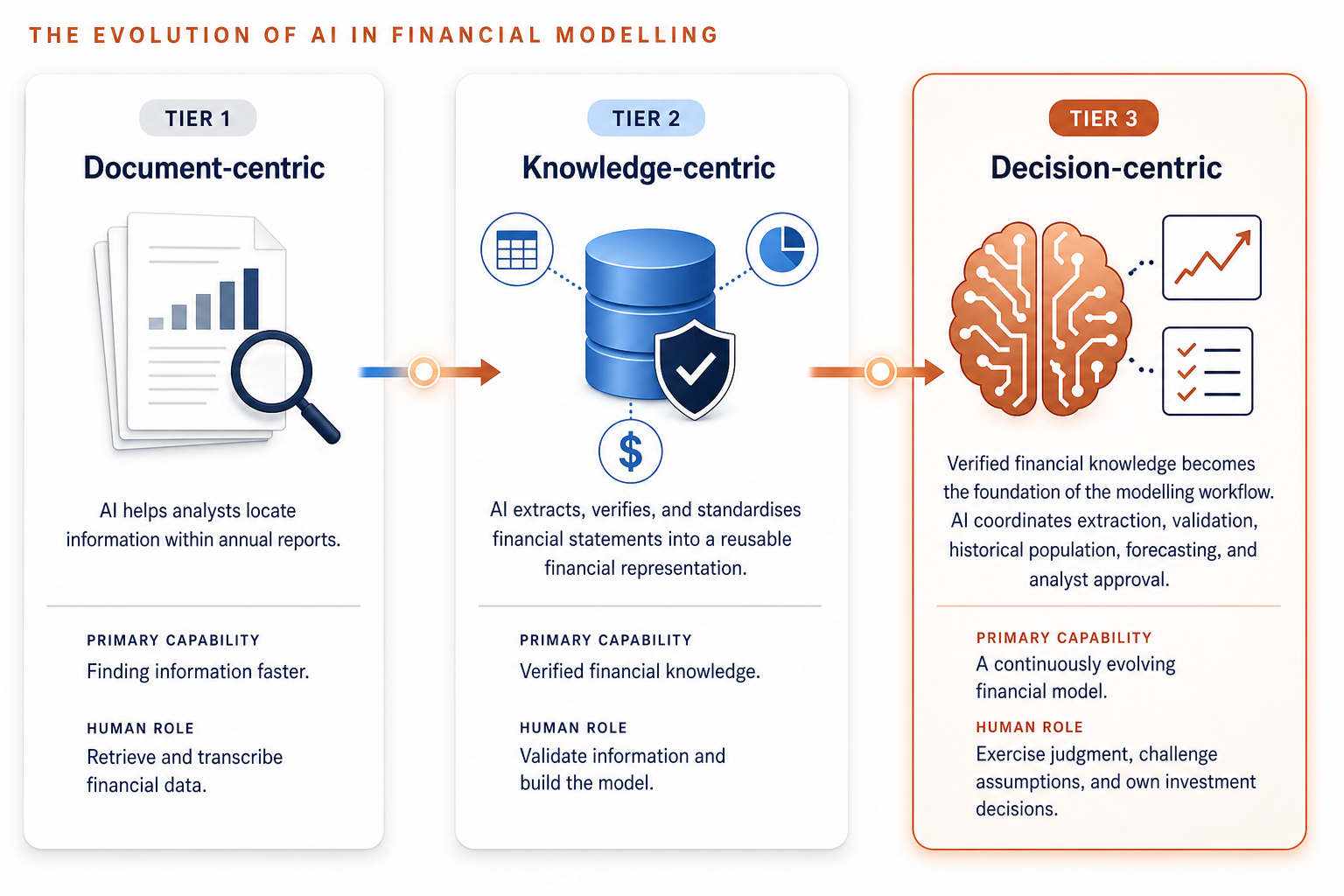
A practitioner's account of building a fully AI-orchestrated 3-statement modelling pipeline: filing ingestion, structured extraction, terminology normalisation, and human-gated forecast approval.
Traditional financial modelling is organised around spreadsheets. We reorganise the workflow around a verified financial knowledge layer.
The problem with traditional modelling
Financial modelling remains constrained by workflows designed for spreadsheets rather than financial knowledge. Annual reports must be repeatedly searched, interpreted, reconciled, and re-entered into models despite representing structured financial statements. As a result, experienced analysts spend most of their modelling effort reconstructing information that already exists instead of evaluating the business itself.
The Dorrsum pipeline — eight stages
01
Import Filing
10-K · 10-Q
02
Extract & Verify
Structured financial digest
03
Build Historical Model
Populate verified actuals
04
Approve Assumptions
Analyst sign-off
05
Generate Forecast
Income Statement · Balance Sheet · Cash Flow
06
Build Supporting Schedules
PP&E · Debt · Revolver
07
Explore Scenarios
Worst · Base · Best
08
Validate Model
Four-way tie-out
Beyond a single AI model
No single AI model performs financial modelling end-to-end.
Dorrsum combines specialised AI capabilities into a structured workflow, where each stage verifies or prepares the next. Extraction feeds verification. Verification enables terminology normalisation. Normalised financial data populates the model, which then supports forecasting through explicit analyst approval gates.
The differentiation is not any individual AI model. As foundation models continue to improve and become increasingly commoditised, the value lies in how they are combined into a reliable financial modelling workflow that is transparent, auditable, and resilient.
Three principles behind the architecture
Principle 1
Financial knowledge before spreadsheets
Every filing is transformed into verified financial knowledge before any data reaches the model. The spreadsheet becomes the destination, not the starting point.
Why it matters
Historical actuals, forecasts, ratios, and future updates all work from the same trusted source of truth.
Principle 2
Models understand meaning, not cells
The pipeline targets financial concepts rather than spreadsheet coordinates. Financial labels are standardised before population, allowing the workflow to remain resilient even when model layouts or filing terminology change.
Why it matters
Automation follows financial meaning instead of Excel positions, making the model easier to evolve and maintain.
Filing label (as seen in 10-K)
Company / context
Model standard label
Total net sales
Apple FY2025
Gross Revenue
Cost of sales — Products / Cost of sales — Services
Apple FY2025
Cost of Sales (COGS)
Income before provision for income taxes
Apple FY2025
Pretax Profit (EBT)
Provision for income taxes
Apple FY2025
Tax Expense
Principle 3
AI recommends. Analysts decide.
AI prepares historical data and proposes forecast assumptions, but every projected value requires explicit analyst approval before entering the model.
Why it matters
Judgment remains visible: every accepted, modified, or rejected assumption is logged against the analyst who made the call.
Services revenue growth — FY2026E
+13.0% YoY · Base case
Accept
Modify
Reject
Financial models should capture financial judgment; manual transcription isn't the point. By treating structured financial knowledge as the foundation rather than the spreadsheet itself, Dorrsum reduces modelling from a document-processing exercise into a decision-making workflow. AI performs the retrieval, reconciliation, and population. The analyst remains responsible for the only part that cannot be automated: judgment.